
Sail Rock is one of the most famous dive sites in the Gulf of Thailand, on the eastern side of the Malay Peninsula. If Richelieu Rock in the Andaman Sea is one of Thailand’s great dive sites in the west, Sail Rock deserves the same reputation in the east.
What makes Sail Rock special is not an extraordinary variety of marine life, but the sheer number of fish. Huge schools gather around this isolated rock, sometimes filling almost your entire field of view. And if you are lucky, a whale shark may suddenly appear right in the middle of them.
Where is Sail rock?
Three popular islands lie roughly north to south in the southern Gulf of Thailand: Koh Tao, Koh Phangan and Koh Samui.
Koh Samui is the largest and best-known resort island. Koh Phangan is famous for backpackers and its Full Moon Party, while Koh Tao is particularly popular with divers and backpackers. The islands are only one or two hours apart by ferry, depending on the route and boat. Sail Rock lies in the open sea roughly between Koh Tao and Koh Phangan.
What makes the Gulf of Thailand different?
The Gulf of Thailand is quite different from many other diving areas in Southeast Asia.
It is a relatively shallow, semi-enclosed body of water with limited exchange with the open ocean. Tidal patterns are also unusual in much of the Gulf, with a strong diurnal component and generally less powerful currents than at many exposed oceanic dive sites.
This environment seems to produce a distinctive underwater landscape.
In my experience, the Gulf of Thailand does not necessarily have the same diversity of species as some other tropical seas. Instead, individual species can occur in enormous numbers.
That is exactly what makes Sail Rock so impressive.
The rock rises from a seabed about 30 meters deep all the way to the surface. There are no major reefs immediately around it, so fish from the surrounding open water concentrate around this single structure.
The already dense fish life of the Gulf of Thailand becomes compressed into a remarkably small area.
The result is an overwhelming amount of fish.
Highlights of the Sail rock
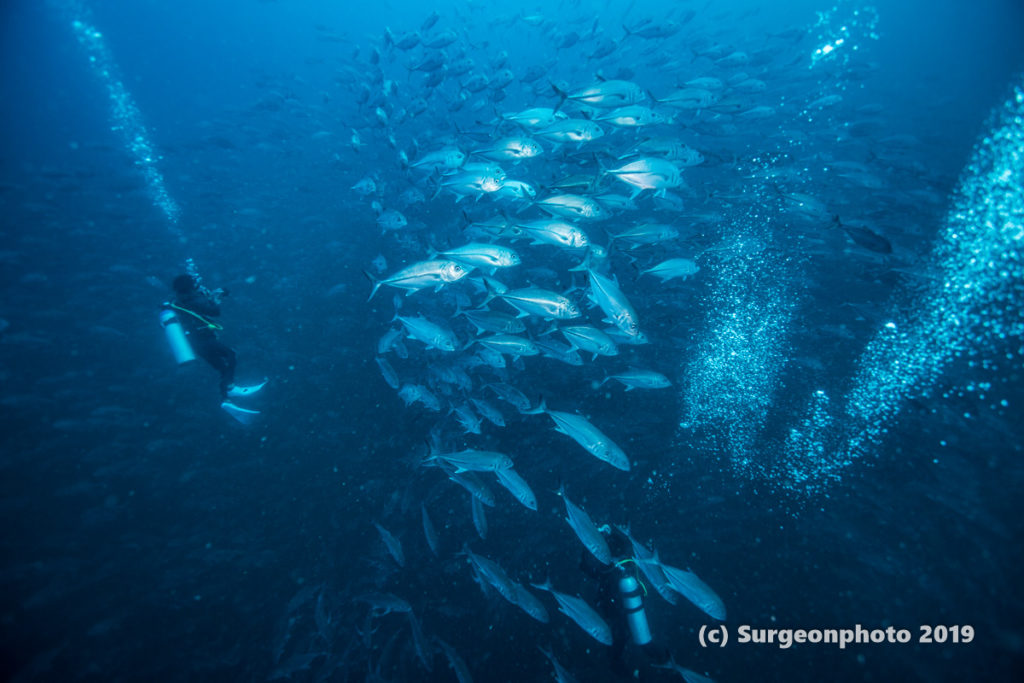
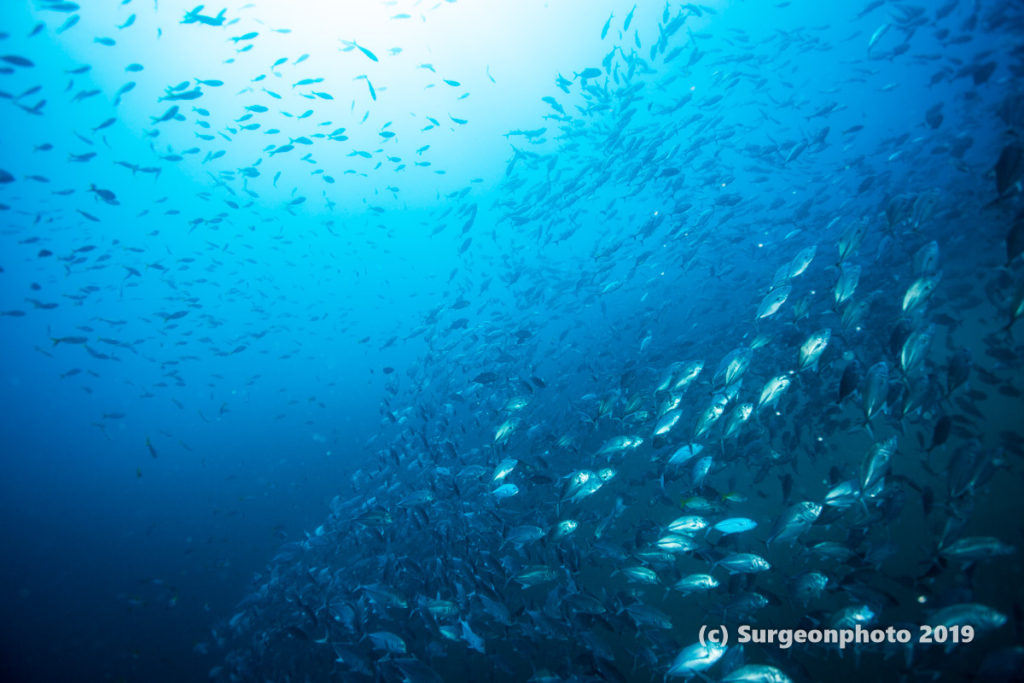
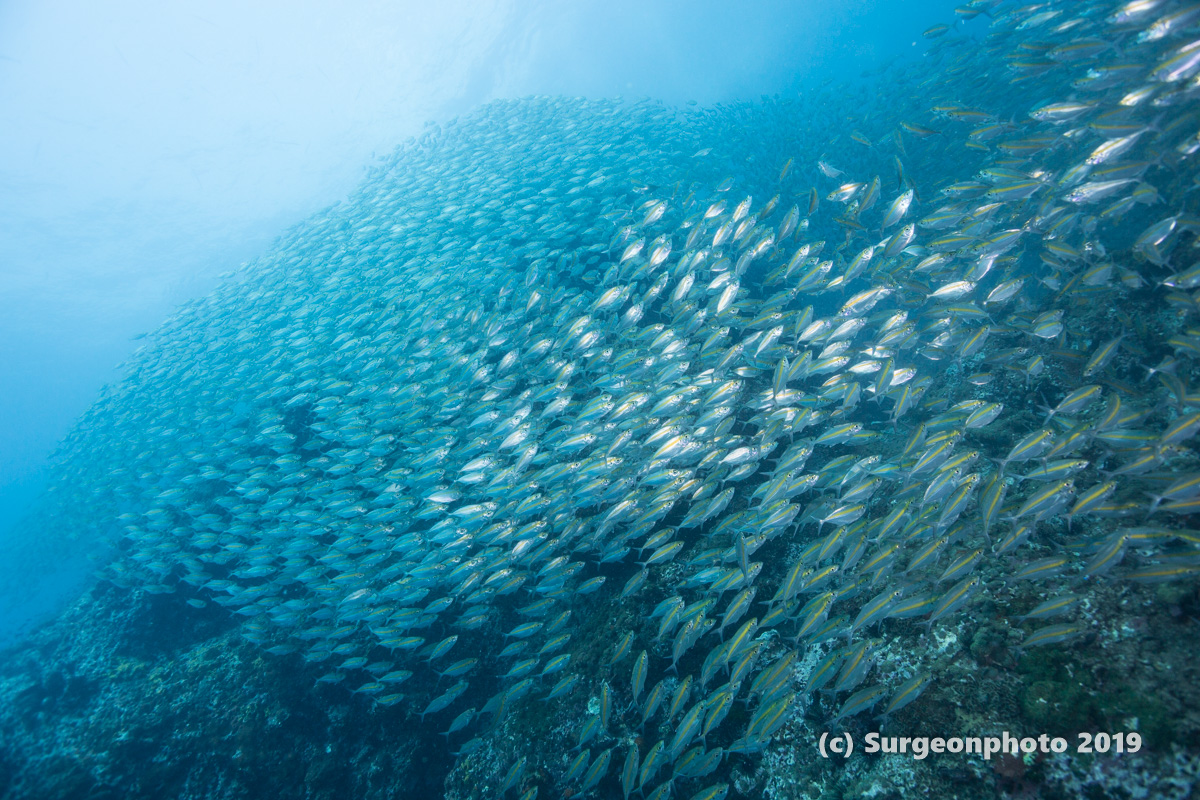
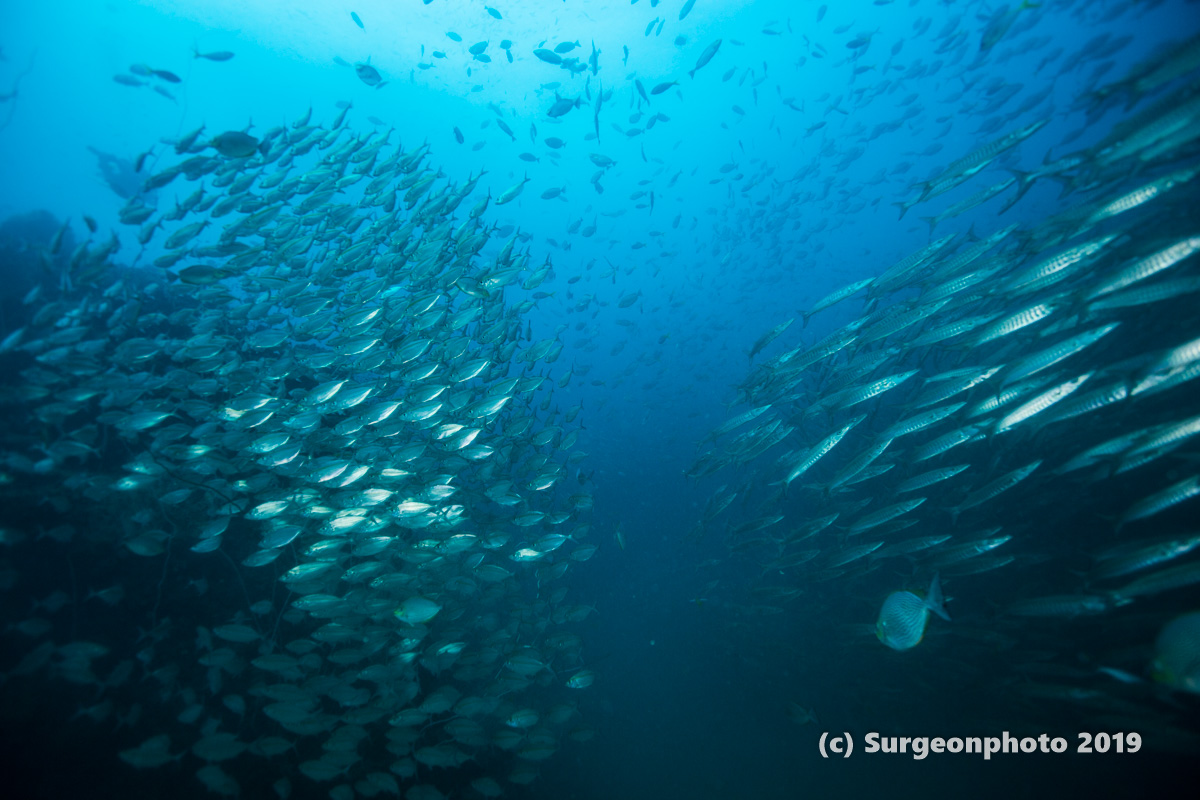
Huge school of big eye trevally
For me, one of the greatest attractions of Sail Rock is the huge school of bigeye trevally.
Depending on conditions, the school may move deeper into darker and murkier water, but you have a good chance of finding it when diving here.
Sometimes the fish are packed together so densely that they block your view of everything beyond them.
Being surrounded by hundreds or thousands of trevally is one of the classic Sail Rock experiences.
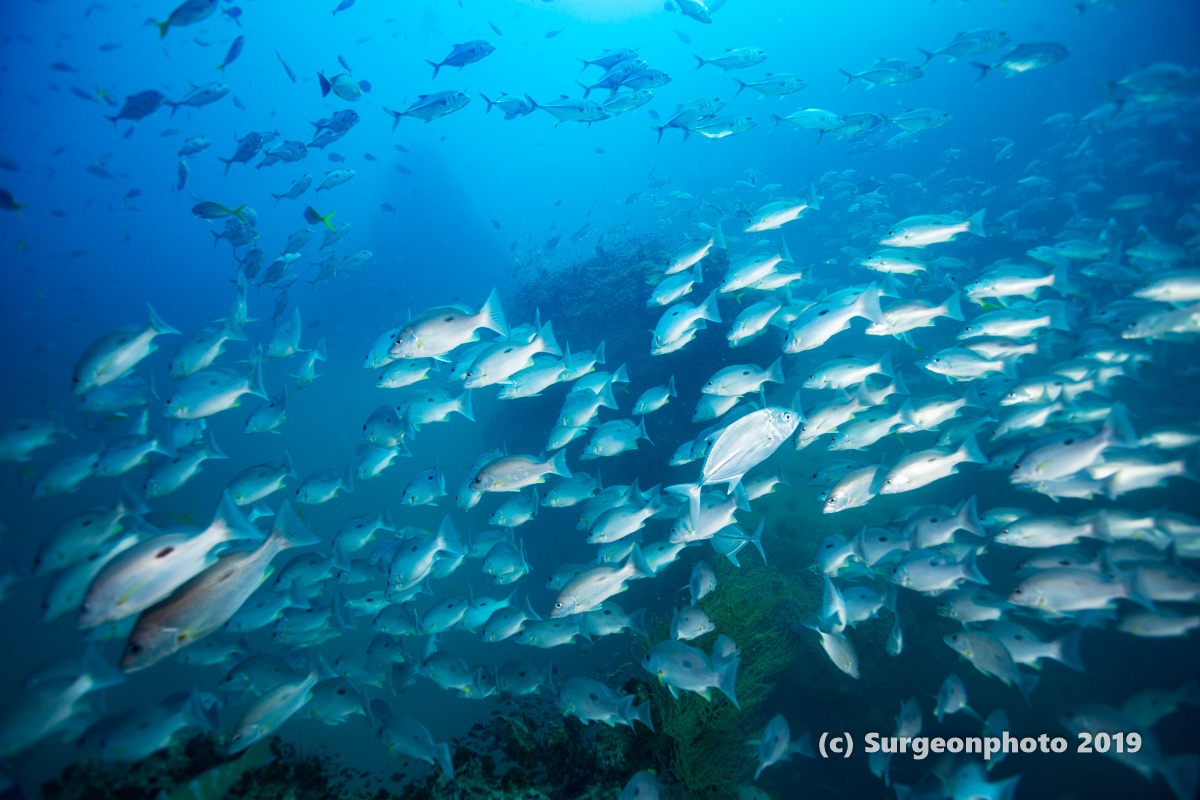
Longfin batfish
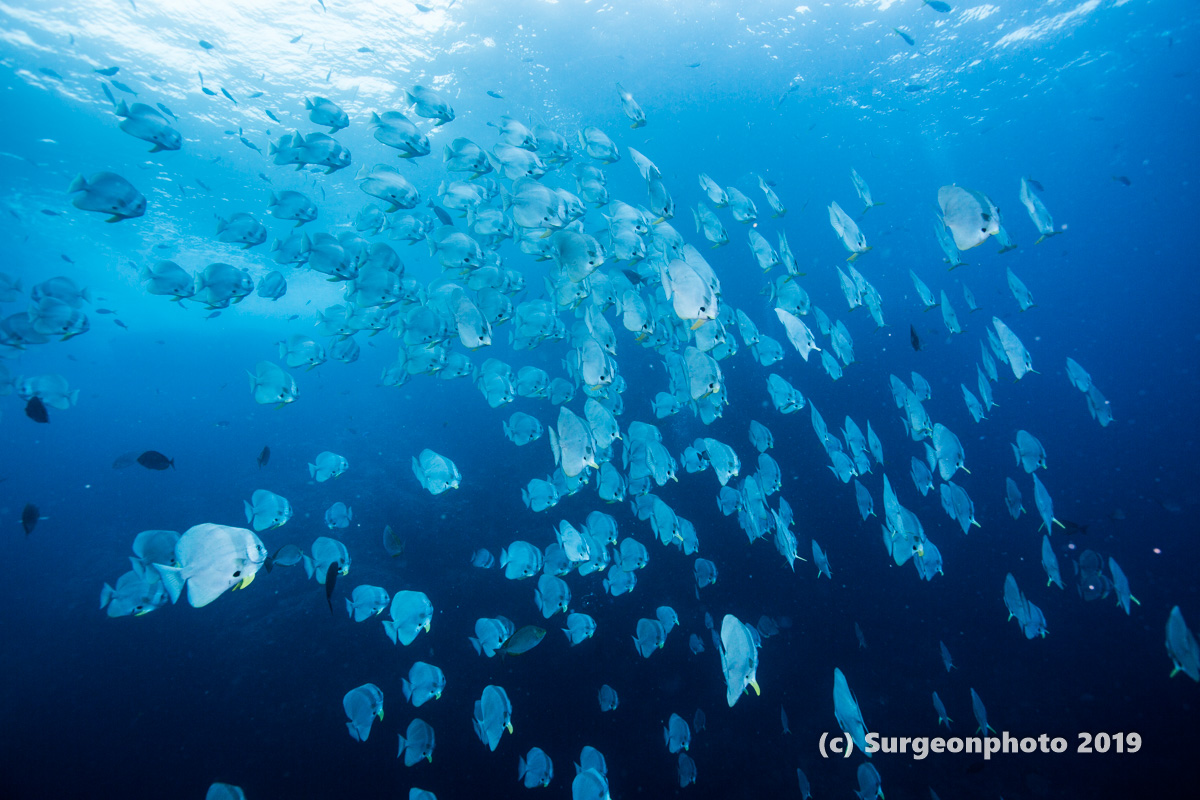
The schools of longfin batfish are another highlight.
Seeing a group of around 20 batfish is not particularly unusual at tropical dive sites, but at Sail Rock the schools can sometimes contain 100 or even several hundred fish.
When a huge school spreads across your entire field of view, the scene is spectacular.
There is a little more luck involved here. The size of the school varies from year to year, and sometimes the main group moves away from the rock.
But when they gather around Sail Rock in large numbers, they are unforgettable.
Chevron barracuda and pickhandle barracuda
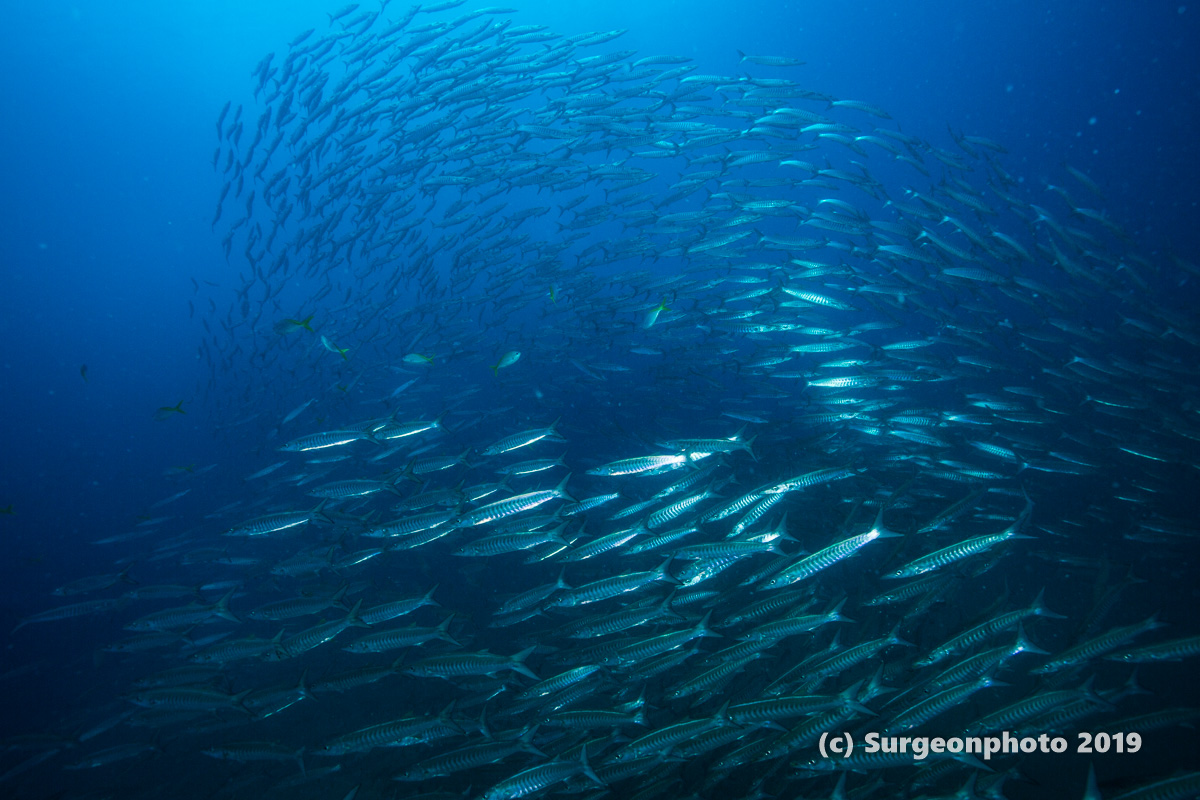
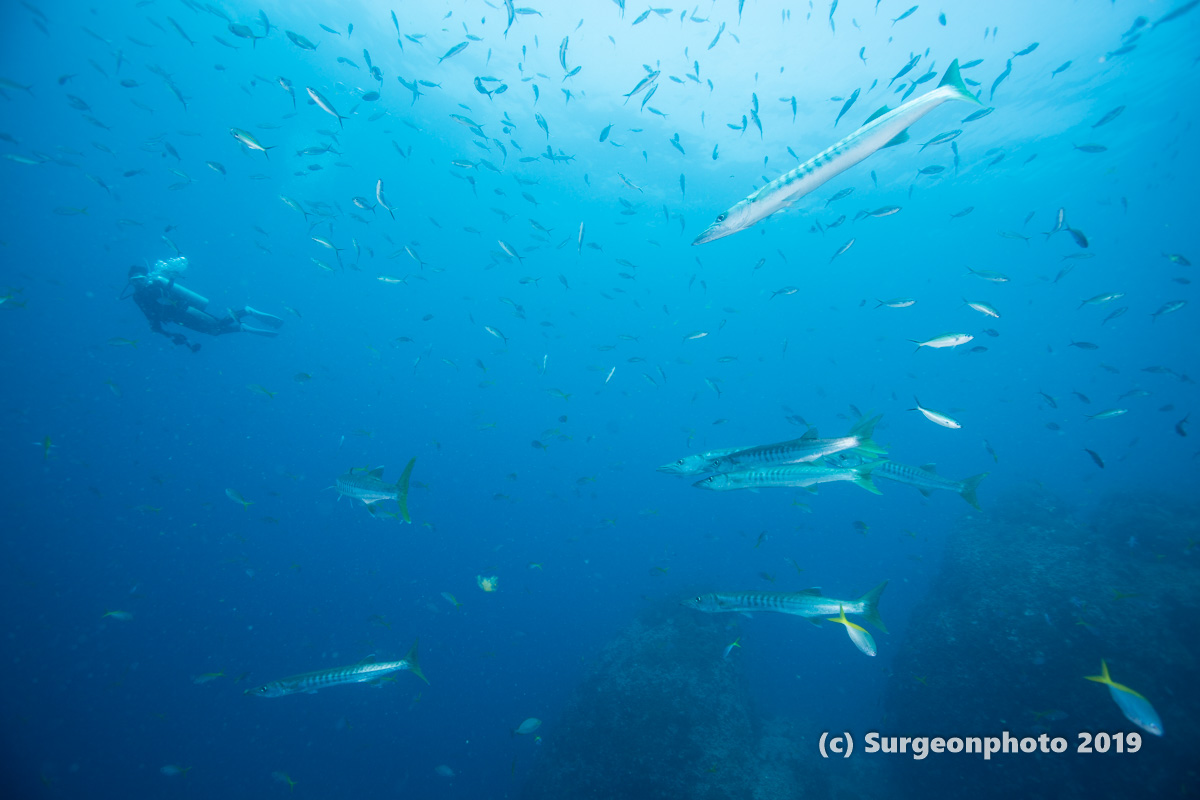
Several species of barracuda can be seen around Sail Rock.
Chevron barracuda often form dense, tightly packed schools. They are medium-sized barracuda, generally around 50 to 80 centimeters long.
Pickhandle barracuda are quite different.
They are much larger, sometimes exceeding one meter in length, and are easy to recognize by their yellowish tail fins. They tend to swim in looser formations rather than forming the dense schools typical of chevron barracuda.
The school may not look as compact, but each individual fish is large enough to be impressive on its own.
Fish everywhere
And those are only some of the major attractions.
Sail Rock is simply full of fish.
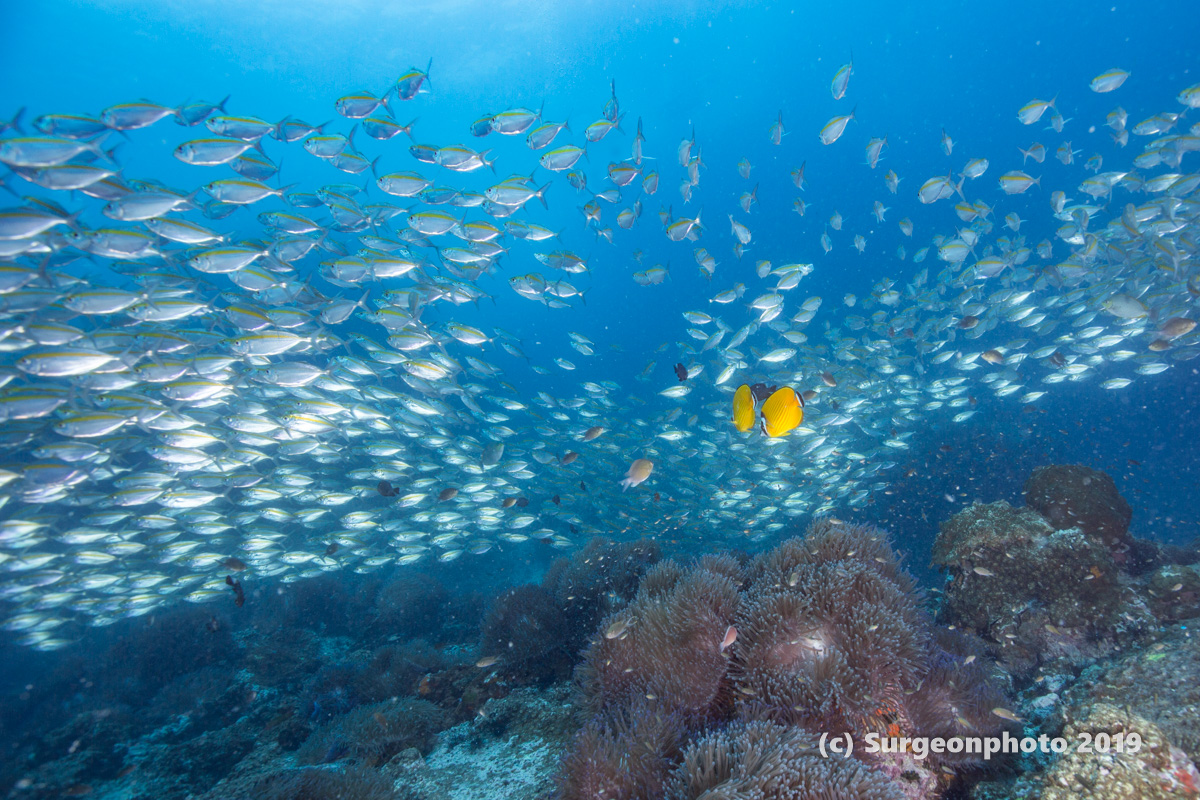
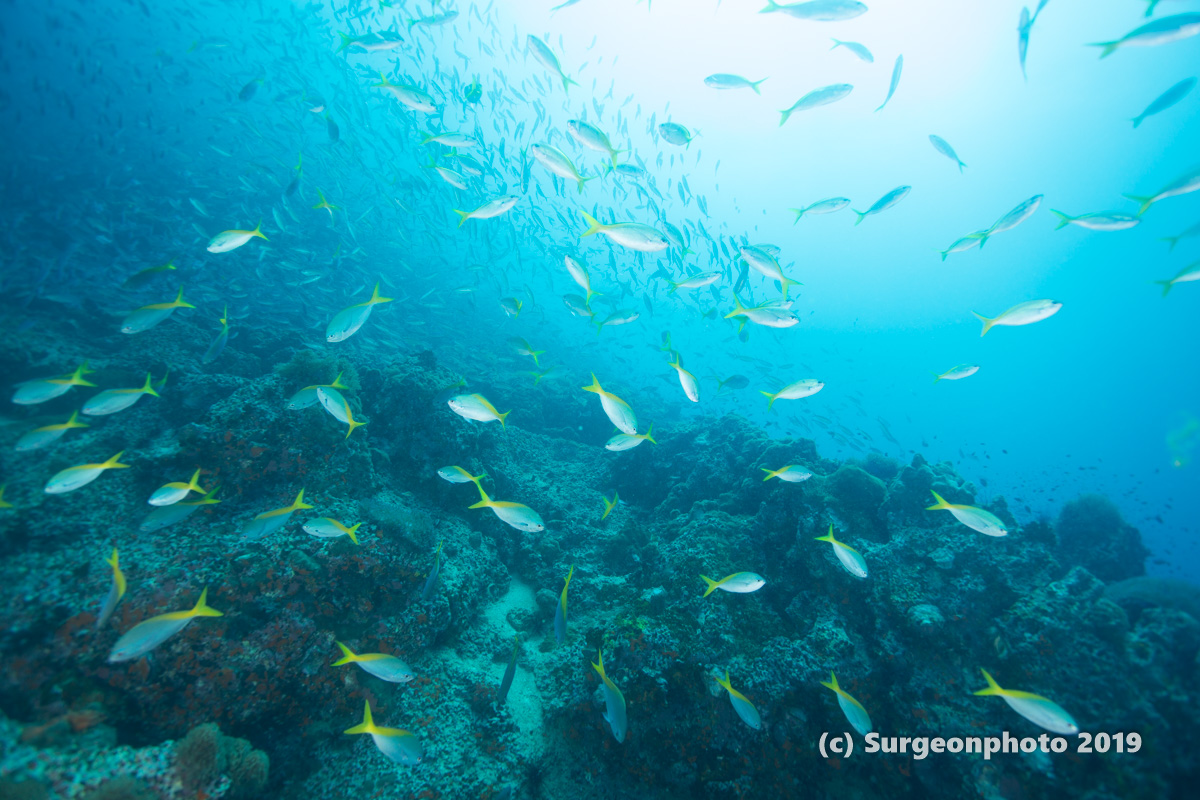
Large schools of oxeye scad, bigeye snapper and fusiliers can surround the rock, often layered one behind another.
It is difficult to describe the density until you actually dive there. At many dive sites, you search for the main attraction. At Sail Rock, the attraction is often the sheer mass of marine life surrounding you.
Whale sharks
The enormous schools of fish alone would make Sail Rock worth visiting.
But there is another reason the site is special: whale sharks.
The chances are not comparable with destinations such as the Maldives or the Galápagos Islands, where whale shark encounters can be considerably more predictable. Still, Sail Rock and the waters around Koh Tao offer a realistic chance of seeing a wild whale shark without feeding or artificial aggregation.
For a destination relatively easy to reach from Japan and elsewhere in Asia, that is a major attraction.
Whale sharks can also be seen on the Andaman Sea side of Thailand, but my personal impression is that Sail Rock and the Koh Tao area offer more opportunities.
And there is something particularly special about seeing a whale shark here.
It does not simply appear in blue water.
It may swim straight through the enormous schools of fish that make Sail Rock famous.
A whale shark surrounded by bigeye trevally.
A whale shark passing a school of hundreds of batfish.
When everything comes together at the same time, it is difficult to imagine a more exciting underwater scene.
The chances of whale shark encounters seem to increase roughly from March to May and again from August to October. For Japanese divers, that conveniently overlaps with Golden Week in spring and the summer holiday season.
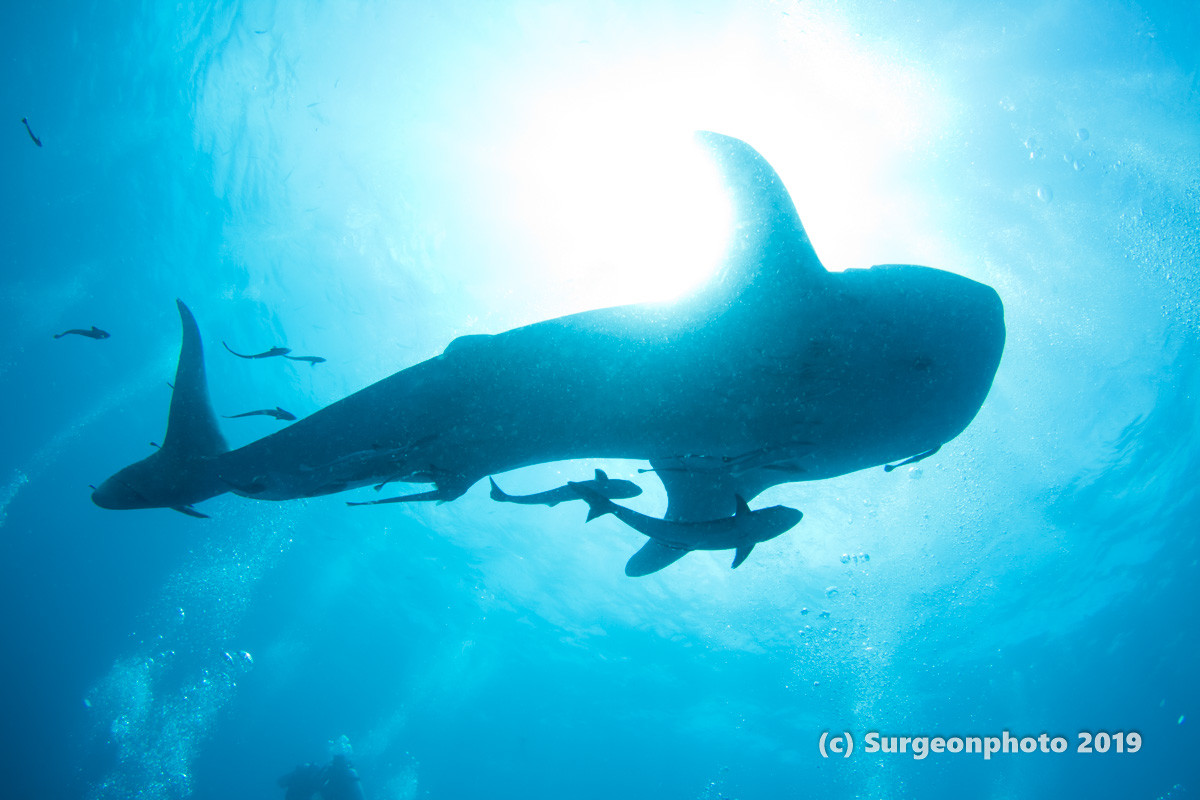
Unfortunately, I do not have my own photograph of a whale shark taken at Sail Rock.
Instead, I have included a photograph taken at Chumphon Pinnacle in the same general area.
There are also excellent recent photographs from local dive operators. Whale sharks have continued to appear at Sail Rock in 2026 as well.
The Chimney
Sail Rock also has something for divers who enjoy underwater topography.
On the northwestern side of the rock is a vertical swim-through known as the Chimney.
The deepest entrance is at around 20 meters, with additional openings at approximately 15 meters and 8 meters.
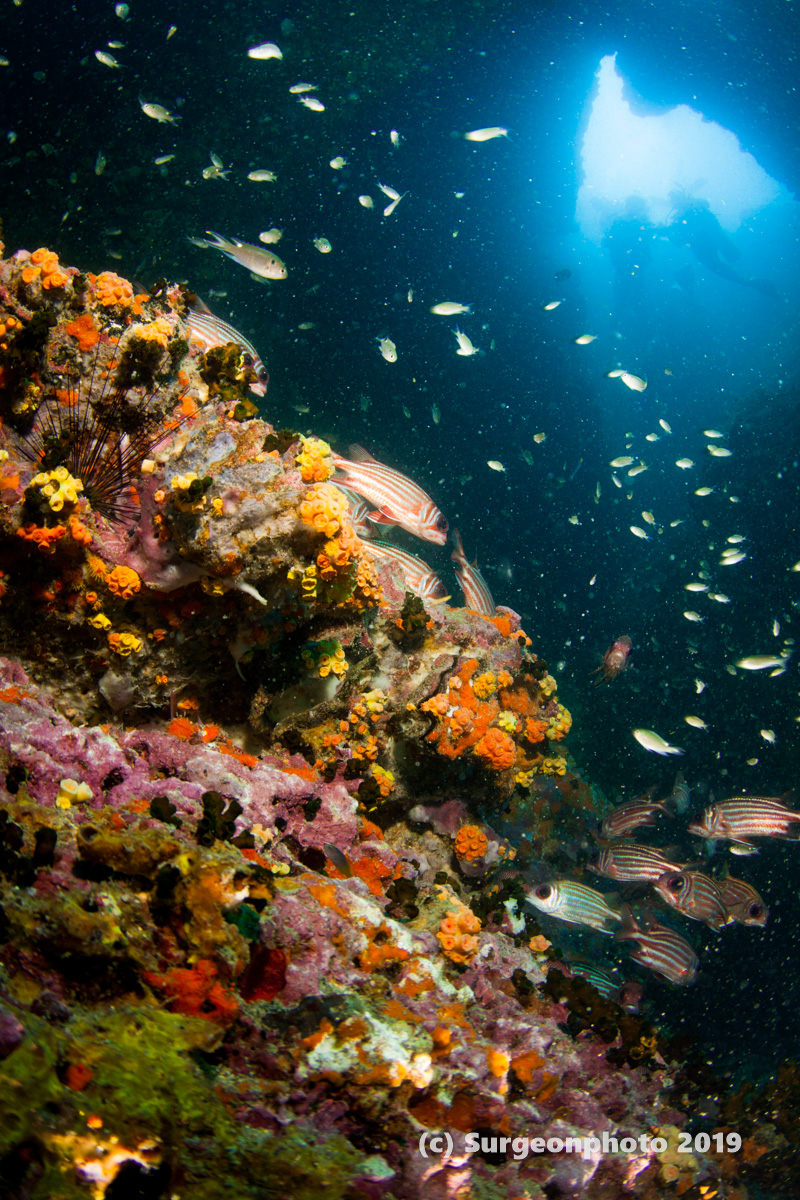
Looking upward through the Chimney toward the light above is beautiful and adds another completely different experience to a dive dominated by huge schools of fish.
Travel infromation
How to dive Sail Rock
The most common ways to dive Sail Rock are on a day trip from Koh Samui or aboard a dive boat from Koh Tao. Some operators on Koh Phangan also run trips to the site.
From Koh Samui, many dive operators use speedboats.
The trip to Sail Rock usually takes around 50 minutes to one hour. A typical schedule is to leave Koh Samui in the morning, make two dives at Sail Rock and then return to the island.
From Koh Tao, larger dive boats are commonly used.
The journey usually takes around 1.5 to 2 hours.
Schedules vary between operators, but some trips include two dives at Sail Rock, lunch on the boat and a third dive at somewhere such as Southwest Pinnacle, Shark Island or another site near Koh Tao before returning to the island.
Other operators offer trips consisting of two dives at Sail Rock only.
Getting to Koh Samui
For most visitors arriving from Japan, the simplest route is to fly to Koh Samui via Bangkok.
Bangkok Airways operates frequent nonstop services between Bangkok and Koh Samui, primarily from Suvarnabhumi Airport, with services also available from Don Mueang.
Thai Airways tickets to Koh Samui may also be available as through itineraries, although the Bangkok–Samui sector itself is operated by Bangkok Airways as a codeshare flight.
There are also international nonstop flights to Koh Samui.
As of 2026, Bangkok Airways operates services from Singapore and Hong Kong, while Scoot also flies between Singapore and Koh Samui.
For travelers coming from Japan, however, Bangkok is generally the easiest connection because of the number of flights and the range of onward options.
Another possibility is to travel overland from Bangkok by train or bus to Chumphon or Surat Thani and then take a ferry to the islands.
You can also fly to Surat Thani Airport and continue by bus and ferry.
These routes can sometimes be cheaper than flying directly to Koh Samui, but they take considerably longer. Unless you have a particular reason to travel overland, flying to Koh Samui is usually the easiest option.
Getting to Koh Tao
A straightforward way to reach Koh Tao is also to fly to Koh Samui first and then continue by ferry.
Several companies operate boats from Koh Samui to Koh Tao, including Lomprayah. Depending on the service, the journey takes roughly 1.5 to 2 hours, and some boats stop at Koh Phangan along the way.
Another option is to travel from Bangkok to Chumphon by train or bus and then take a ferry to Koh Tao.
For the outbound journey, this is not necessarily much more convenient than traveling via Koh Samui.
On the way home, however, it can be surprisingly useful for serious divers.
A route for people who want two more dives
Koh Tao has dive boats that leave early in the morning and complete two dives before or around midday.
After those dives, it is possible to take an afternoon ferry from Koh Tao to Chumphon and then continue by bus to Bangkok.
Lomprayah continues to offer ferry-and-bus connections that leave Koh Tao in the afternoon and arrive in Bangkok late at night.
This can create an interesting itinerary.
If you return via Koh Samui and fly onward, the final day often becomes a travel day with no diving. By traveling from Koh Tao to Chumphon instead, you may be able to squeeze in two additional dives that morning, travel to Bangkok that evening, and then fly home the following day.
Of course, you must allow sufficient surface interval before flying.
After multiple dives or several consecutive days of diving, at least 18 hours before flying is generally recommended, so always check the finishing time of your last dive against the departure time of your flight.
It is certainly a demanding itinerary.
But compared with simply leaving Koh Tao in the morning and flying out through Koh Samui, it may give you two extra dives.
This route is probably best suited to people who think, “Why waste half a day when I could be underwater?”
In other words, diving addicts.
Diving season
The main diving season in this part of the Gulf of Thailand runs roughly from February to October.
Late November through January is the wetter period, when weather and sea conditions are generally less favorable. This seasonal pattern is different from the rainy season experienced in many other parts of Thailand.
During the main diving season, the general range of marine life does not change dramatically from month to month.
Whale sharks are the major exception.
Sightings are often considered more likely from around March to May and again from August to October.
But even without a whale shark, Sail Rock is one of those dive sites where the sheer density of fish can make an ordinary dive feel extraordinary.
コメント